
THE BLOOD OF GILGIT-BALTISTAN: HOW THE MARTYRDOM OF CHILDREN AND SYSTEMATIC BRUTALITY IS DECIMATING THE MYTH OF THE "PROTECTOR"

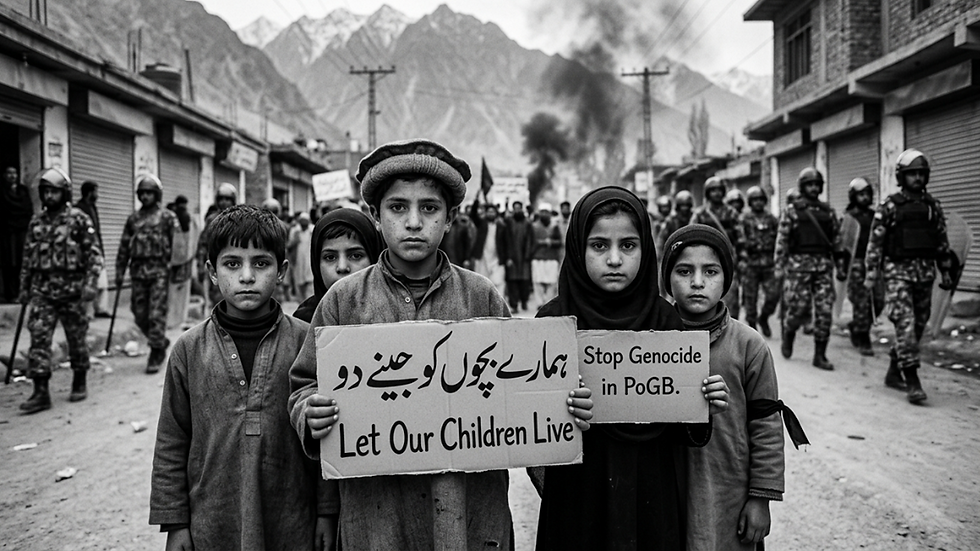
The rugged peaks of Gilgit-Baltistan have long echoed with the cries of its people, but today, those echoes have turned into a thunderous roar of defiance. The recent killing of Shia children and youth—the very future of the region—during protests has ripped the mask off the military establishment. From the streets of Gilgit to the towns of Muzaffarabad, the sentiment is no longer one of mere grievance; it is a visceral rejection of an occupying force. By turning its guns on innocent civilians, the Pakistan Army has not just silenced voices; it has permanently severed the emotional and political ties that once tethered these regions to the center.
The tragedy in Pakistan Occupied Gilgit-Baltistan (PoGB) reached a tipping point when the state responded to peaceful assembly with lethal kinetic force. During demonstrations—some ironically sparked by the fallout of broader geopolitical tensions like the US-Iran friction—the local Shia population found themselves in the crosshairs. The killing of Shia children is not a tactical error; it is a message.
For the people of PoGB, these children represent the ultimate sacrifice. When a state begins to fear its youth and responds with bullets, it admits its moral bankruptcy. These killings have acted as a catalyst, bridging the gap between sectarian identities and uniting the region under a singular banner of resistance against state-sponsored tyranny.
The killings are only the visible tip of a much darker iceberg: the systemic machinery of enforced disappearances. For decades, the Pakistan Army has used "the missing" as a psychological weapon to break the spirit of the local population. Activists, students and community leaders who dare to question the deprivation of their natural resources or the lack of constitutional rights vanish into the "black holes" of military detention centers.
In PoGB and POK, the fear of the "Vigo" (the infamous vehicle associated with abductions) is being replaced by a defiant anger. Families of the disappeared are no longer mourning in private; they are taking to the streets, demanding accountability. This practice has exposed the paradox of a state that claims to protect these territories while treating their inhabitants as subjects with no right to habeas corpus.
The global community has long viewed Pakistan as the cradle of terrorism, a sanctuary where non-state actors are groomed as strategic assets. However, the residents of PoGB and POK are the primary domestic victims of this policy. While the state harbours extremists, it labels peaceful local protesters as "anti-state" or "terrorists."
The irony is lethal. The same military apparatus that provides safe haven to UN-designated terrorists uses "anti-terror" laws like the Fourth Schedule to freeze the bank accounts and restrict the movement of local Shia clerics and political workers. The people now see clearly: the "terrorism" the state claims to fight is often a bogeyman used to justify the heavy militarization of their homes, while the real threat remains the state’s own policy of radicalization.
For years, the establishment has employed a "divide and rule" strategy, exploiting the long-standing Shia-Sunni divide to prevent a united front in Gilgit-Baltistan. By engineering demographic changes and state-sponsored sectarian friction, the center managed to keep the locals fighting each other rather than questioning the extraction of their minerals and water.
However, the recent bloodshed has backfired. The targeting of Shia youth has led to a rare and powerful moment of cross-sectarian solidarity. People are realizing that whether they are Shia or Sunni, they are equally disenfranchised by an army that views the land for its strategic value but the people as a liability. The divide is narrowing and the focus has shifted towards the common oppressor.
The fire ignited in Gilgit has quickly spread to "Pakistan Occupied Kashmir" (POK). The resentment in POK has reached unprecedented levels, fuelled by soaring inflation, heavy taxes and the blatant exploitation of Neelum River’s resources while the locals suffer in darkness.
When the people of Muzaffarabad see the children of Gilgit being martyred, they see their own future. The slogan of "Kashmir Banega Khudmukhtar" (Kashmir will become independent) is gaining ground, not because of external influence, but because of internal betrayal. The POK population, once seen as the "base camp" for the state's narrative, is now openly chanting slogans against the military high command. The "protector" has been unmasked as a "predator" that consumes the resources of the poor to fund the luxuries of the elite.
The region's unique demographic makeup makes it sensitive to Middle Eastern geopolitics. Protests regarding the US-Iran conflict are often used by the state as an excuse to crack down on the Shia population under the guise of "national security." By treating the local Shia community as a fifth column for Iran, the Pakistan Army justifies its brutality. This externalization of domestic issues is a desperate attempt to delegitimize a homegrown movement for rights and dignity.
Pakistan stands at a crossroads where its peripheral territories are no longer willing to be silent bystanders to their own extinction. The killing of children in PoGB has created a "Generation of Resistance" that does not fear the gallows or the prison cell.
The Pakistan Army’s reliance on enforced disappearances, sectarian manipulation and brute force is a failing strategy. You cannot build a nation on the graves of its children. The resentment brewing in PoGB and POK is a clear signal: the era of blind submission is over. If the state continues to act as a "cradle of terrorism" while acting as a graveyard for its own citizens, it will find that the very ground it seeks to occupy has turned into a volcano of revolution.
The blood spilled on the cold streets of Gilgit has written a new chapter—one where the people are finally reclaiming their voice, their land and their future from the clutches of an oppressive military regime.


Comments