
THEIR SACRIFICE AT PULWAMA WILL NEVER BE FORGOTTEN

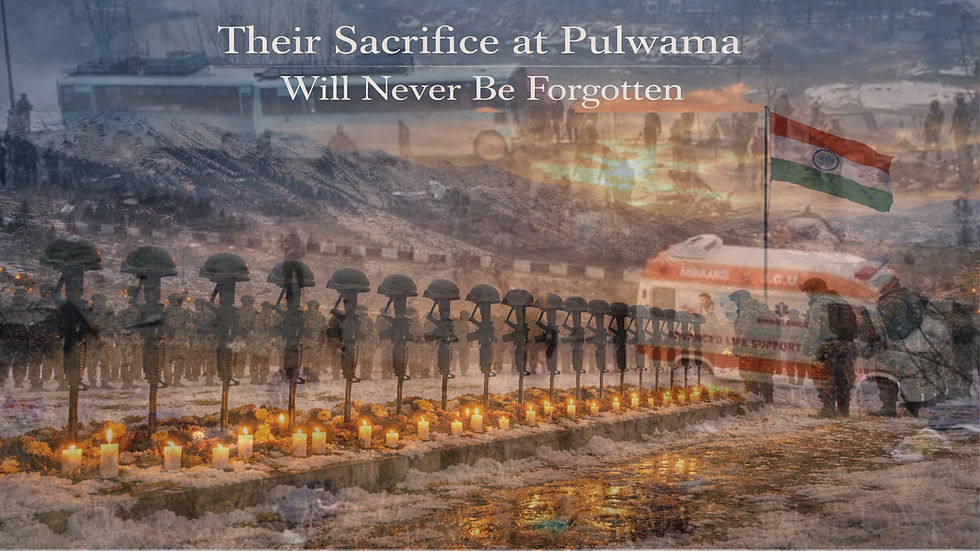
On the afternoon of 14 February 2019, when most of the world was celebrating love and companionship, the quiet winter roads of south Kashmir witnessed one of the darkest days in India’s contemporary history. Along the Jammu–Srinagar National Highway near Lethpora, Pulwama, a convoy of Central Reserve Police Force personnel moved slowly through the snow-covered landscape. It was a routine movement something that had happened thousands of times before.
A suicide bomber rammed an explosive-laden vehicle into one of the buses in the convoy. A massive blast shattered the valley’s silence, echoing across the mountains. Smoke rose into the sky, debris scattered across the highway, and the nation lost 40 brave Central Reserve Police Force personnel. It was not merely an attack on a security convoy; it was an attack on the conscience of India. The Pulwama attack did not just kill soldiers - it shook a nation awake.
Kashmir has long been accustomed to tension, but the scale and nature of this attack were unprecedented. The convoy consisted of more than 70 vehicles carrying over 2,500 personnel who were returning to their duties after winter leave. Due to heavy snowfall and closure of the highway for several days, a large number of troops were traveling together a factor that made the attack especially devastating.
The explosion was so powerful that it was heard kilometres away. Locals rushed out of their homes, not knowing what had happened. Within minutes, sirens, rescue teams and security forces reached the site. The aftermath was grim - shattered buses, scorched earth and scattered belongings: boots, uniforms, identity cards and other things taken along by soldiers either from their homes or previous place of postings. Many of those who lost their lives were young - some in their twenties, some the sole breadwinners of their families. They came from every corner of India: Uttar Pradesh, Punjab, Rajasthan, Tamil Nadu, Bihar, Himachal Pradesh and beyond. In death, they became a powerful symbol of India’s unity a reminder that the nation is bound not by geography but by sacrifice.
The Pulwama martyrs were not merely uniformed personnel; they were sons, husbands, fathers and brothers. Some had spoken to their families just hours before the attack. One soldier had promised to attend his sister’s wedding after joining the new place of posting. Another had named his newborn child only days earlier. Many were planning to go home after completing their posting. Their lives were ordinary, yet their duty was extraordinary.
They chose a profession where the possibility of death was never distant. Every posting, every patrol and every convoy journey carried risk. Yet they served quietly and without complaint so that millions of citizens could live normal lives. The real meaning of patriotism often reveals itself not in speeches but in silent service. Statistics often reduce tragedy to figures: 40 killed, dozens injured. But Pulwama was not a number it was 40 separate worlds destroyed. Across India, villages and towns turned into mourning grounds. Coffins wrapped in the tricolour arrived at homes where families waited with disbelief. Mothers fainted. Children clung to photographs. Wives stood still, unable to comprehend the permanence of loss.
Television screens showed funeral pyres burning simultaneously in different states. In each place, crowds gathered strangers, school children, elderly citizens all standing in silence. Many had never met these soldiers, yet they cried as if they had lost a family member. For a moment, political differences, social divisions and regional boundaries disappeared. India mourned together.
The Pulwama attack triggered one of the largest emotional reactions in modern Indian history. Candle marches were held in cities and villages alike. Students wrote letters to the families of martyrs. Shopkeepers closed markets voluntarily. Social media flooded with tributes, poems and pledges of solidarity.
What made the moment unique was the collective response. From metropolitan cities to remote hamlets, people stood together in grief and anger. Citizens donated generously to welfare funds supporting the families of the fallen. Many families received assistance not only from the government but also from ordinary citizens. In a country of immense diversity, Pulwama became a shared emotional experience a moment when national identity overshadowed every other identity.
The attack also marked a significant shift in India’s security and counter-terrorism thinking. It exposed vulnerabilities in convoy movement, intelligence coordination and internal security arrangements. Investigations revealed the use of a large quantity of high explosives and the involvement of local radicalization combined with cross-border planning and support.
The incident forced authorities to re-evaluate operational procedures. New convoy protocols, increased aerial surveillance, improved intelligence coordination and technological monitoring systems were gradually implemented. The focus shifted toward prevention rather than reaction.
Pulwama became a turning point in counter-terror strategy not only tactically but psychologically. It reinforced the understanding that terrorism in the region was no longer confined to sporadic attacks but could escalate into high-impact operations designed for maximum casualties and media attention.
For Kashmir itself, the attack carried a complicated emotional weight. While the rest of India reacted with grief and anger the valley experienced fear, anxiety and uncertainty. Ordinary residents feared escalation of violence and instability. Parents worried about safety; students worried about education and businesses worried about survival. Many locals quietly expressed sorrow, condemning the loss of human life. The tragedy reminded people that conflict spares no one neither soldiers nor civilians.
The attack also intensified debate within Kashmiri society about militancy, radicalization and the cost of prolonged conflict. For many, it became a painful reminder that violence ultimately consumes the very society in whose name it is often justified.
The national response went beyond mourning. Diplomatic and security measures followed, signaling a new assertiveness in dealing with cross-border terrorism. The message was clear: attacks of such magnitude would not be treated as routine incidents. Internationally, the attack drew widespread condemnation. Countries across the world expressed solidarity with India and denounced terrorism. The global reaction reflected growing recognition that terrorism is a shared threat transcending border. Pulwama thus became not only a national tragedy but also part of the global conversation on counter-terrorism.
Years have passed since that winter afternoon, yet the memory remains vivid. Every year on 14 February, tributes pour in once again. Schools hold remembrance ceremonies; security forces conduct memorial parades and citizens light candles. Because the sacrifice was deeply personal. These men did not die in a distant war; they died on a highway, in peacetime, performing routine duty. Their sacrifice symbolizes the everyday risks undertaken by security personnel across the country. For most citizens, safety is normal. For soldiers, safety is a mission.
The word “martyr” is often used, but its meaning deserves reflection. Sacrifice does not only mean dying in battle. It means living a life where danger is accepted as duty. Every day away from family, every festival spent at a post, every cold night in harsh terrain is part of that sacrifice. The Pulwama personnel embodied this reality. They were not heroes because they sought glory. They were heroes because they fulfilled responsibility. Their legacy reminds society of an uncomfortable truth: peace is not automatic; it is protected. Pulwama teaches multiple lessons strategic, social and moral. Strategically, it emphasizes constant vigilance and adaptation in security practices. Terrorism evolves and counter-measures must evolve faster.
Socially, it highlights the importance of unity. Divisions weaken resilience, while collective solidarity strengthens a nation’s ability to confront crises. Morally, it reminds citizens of their responsibility toward those who defend them. Respect for security forces should not be limited to moments of tragedy but reflected in everyday civic behaviour and national discourse.
The memory of Pulwama should never be confined to political arguments. The martyrs did not belong to any ideology, party or region. They belonged to the nation as a whole. Their sacrifice demands remembrance beyond anniversaries through responsible citizenship, rejection of violence and commitment to peace. Honouring them means striving for a society where such tragedies become unnecessary.
History remembers events not only by scale but by emotional impact. Pulwama entered national memory because it touched every household. For many, it was the moment when the distant idea of conflict became real and immediate. Photographs of smiling soldiers, conversations they had hours before their deaths and the silent grief of their families etched the event into collective consciousness. These memories cannot fade easily because they represent the price of national security. The martyrs of Pulwama gave their today so others could have a tomorrow.
The Pulwama attack was a tragedy born of violence, but it revealed something powerful the resilience of a nation and the courage of ordinary men in extraordinary circumstances. The loss was immense, yet the unity that followed showed that sacrifice can strengthen collective resolve. Their lives were brief, but their meaning endures. Long after political debates fade and headlines change, the memory of those 40 Central Reserve Police Force personnel will remain not merely as victims of an attack, but as guardians who stood between danger and society.
The road at Lethpora is just a stretch of highway, yet it has become sacred ground in national memory. Every passing year reminds us that freedom and normalcy carry unseen protectors.
Their sacrifice at Pulwama will never be forgotten - because a nation built on remembrance cannot allow its heroes to fade into silence.


Comments